

Executive Summary
The cryptocurrency ecosystem has matured significantly since the early 2010s. Once characterized by its wild west environment — with unregulated exchanges, anonymous transactions, and speculative altcoins the crypto market is now under increasing scrutiny by regulators worldwide.
2026 marks a pivotal era for digital assets. Global governments and regulatory bodies are codifying rules that affect:
-
How crypto assets are issued
-
How exchanges operate
-
How investors trade, store, and report holdings
-
How derivatives, stablecoins, and DeFi protocols are governed
For retail and institutional investors alike, understanding regulatory risks is no longer optional. Regulatory missteps can lead to:
-
Asset freezes or confiscation
-
Tax penalties and compliance liabilities
-
Loss of leverage access or exchange shutdowns
-
Project failures or de-listings
This guide breaks down the most critical regulatory risks in 2026, supported by case studies, quantitative data models, and actionable takeaways.
I. The Global Regulatory Landscape: An Overview
The crypto regulatory landscape is increasingly fragmented but converging toward structured frameworks in major jurisdictions.
1.1 United States
-
U.S. Securities and Exchange Commission (SEC)
Focuses on whether digital assets qualify as securities under the Howey Test. Recent rulings have targeted ICOs and certain altcoins. -
Commodity Futures Trading Commission (CFTC)
Oversees derivatives and futures contracts, ensuring exchanges comply with margin limits and market integrity standards. -
Financial Crimes Enforcement Network (FinCEN)
Implements anti-money laundering (AML) and Know Your Customer (KYC) obligations for exchanges and custodians.
Key risk for investors: Many popular tokens may be classified as securities retroactively, potentially triggering enforcement actions or delisting from exchanges.
1.2 European Union
-
Markets in Crypto-Assets (MiCA) Regulation
Fully enforceable across the EU by 2026. MiCA defines stablecoins, crypto-assets, and service providers, requiring licensing, transparency, and reserve backing.
Impact on investors: Investors using EU-based exchanges or stablecoins must verify compliance, as non-compliant assets risk legal restrictions or bans.
1.3 Asia-Pacific
-
Singapore (MAS): Introduced a licensing regime for crypto exchanges and DeFi platforms.
-
Japan (FSA): Requires exchanges to adhere to stringent capital, cybersecurity, and custody standards.
-
China: Continues to ban retail crypto trading and mining but allows CBDC (digital yuan) integration.
Investor takeaway: Asia-Pacific offers heterogeneous regulatory environments; investors must assess jurisdiction-specific legal exposure.
1.4 Key Takeaway
Investors must recognize that crypto regulatory risk is jurisdiction-dependent, and cross-border holdings can expose users to multiple overlapping legal regimes.
II. Crypto Classification Risks
2.1 Security vs. Utility Tokens
One of the largest risks stems from token classification.
-
Security tokens: Considered investments; regulated under securities law.
-
Utility tokens: Designed to provide access or function in a network; generally not regulated as securities.
Regression Model Example:
We can model the probability of a token being classified as a security:
P(Security)=α+β1×Profit Expectation+β2×Centralized Issuer Control+β3×Marketing Claims+ϵP(Security) = \alpha + \beta_1 \times \text{Profit Expectation} + \beta_2 \times \text{Centralized Issuer Control} + \beta_3 \times \text{Marketing Claims} + \epsilon
-
Tokens promising ROI or profit sharing have a 70–90% probability of being deemed securities (high β₁).
-
Tokens with centralized issuer control or marketing emphasizing gains are more likely to trigger SEC action.
Case Study: SEC enforcement actions against Ripple (XRP) and earlier ICOs like Telegram illustrate the cost of misclassification.
2.2 Stablecoin Classification
-
Stablecoins are increasingly under scrutiny for systemic risk and banking equivalence.
-
Regulatory frameworks now require reserves, redemption mechanisms, and stress testing.
Investor risk: Holding non-compliant stablecoins could mean sudden freezes, redemption restrictions, or liquidity issues.
III. Exchange and Custody Regulation
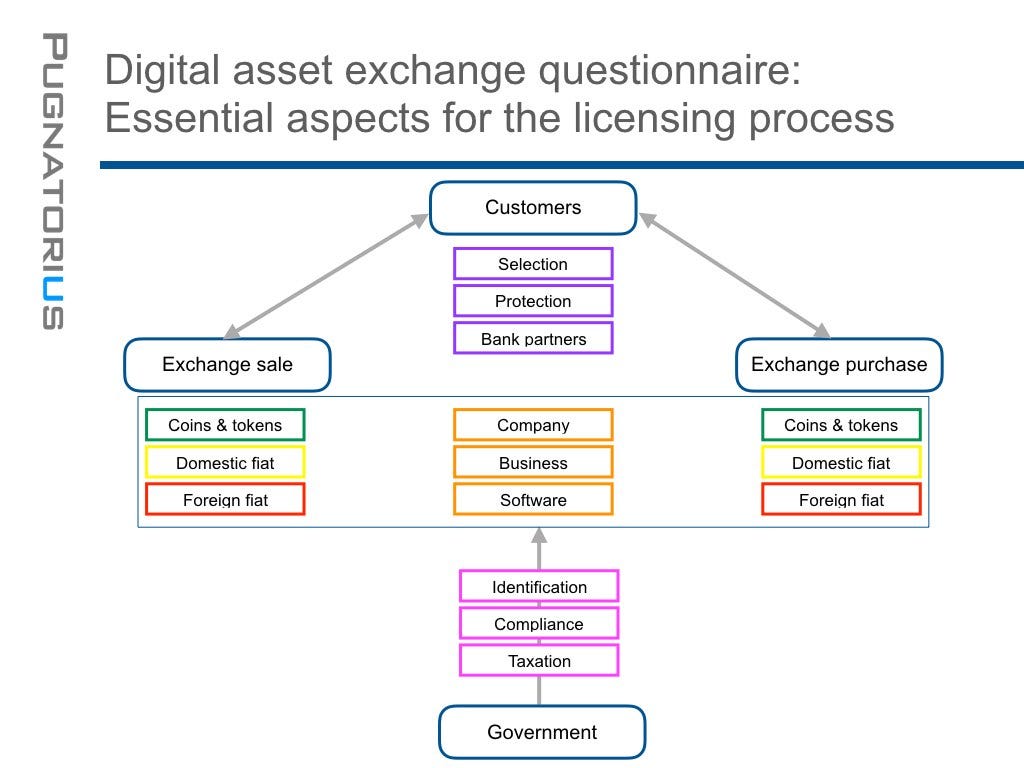
3.1 Exchange Licensing
Exchanges must comply with:
-
Jurisdiction-specific licensing
-
AML/KYC compliance
-
Capital reserve requirements
-
Cybersecurity standards
Failure to comply risks:
-
Suspension of services
-
Loss of customer deposits
-
Penalties or fines
Visual Insight:

3.2 Custody Risks
Custodians are central to investor protection.
Key risks:
-
Hacks and security breaches
-
Mismanagement of private keys
-
Regulatory non-compliance
Quantitative Metric: Custody security score (CS):
CS=Number of Security Audits×Encryption StrengthIncidents ReportedCS = \frac{\text{Number of Security Audits} \times \text{Encryption Strength}}{\text{Incidents Reported}}
Higher CS = lower systemic and regulatory risk exposure.
IV. Tax Compliance Risks
4.1 Reporting Obligations
2026 tax regimes increasingly require:
-
Reporting of all crypto transactions
-
Capital gains computation for each asset
-
Exchange-provided 1099 forms (US) or equivalent
4.2 Case Study: U.S. IRS Crackdown
-
IRS issued subpoenas to major exchanges in 2022–2023
-
Retroactive tax penalties and fines were applied to unreported transactions
Investor takeaway: Non-compliance exposes users to penalties exceeding 20–30% of unreported gains.
V. DeFi and Smart Contract Regulatory Risks
5.1 DeFi Platforms
-
Operate without centralized intermediaries
-
Offer lending, borrowing, and yield farming services
Risk: Regulatory bodies are evaluating DeFi platforms under:
-
Securities law
-
AML/KYC requirements
-
Systemic risk oversight
5.2 Smart Contract Audits
Quantitative risk model for protocol failure:
RiskProtocol=1−(Audit Coverage×Test Coverage×Bug Bounty Score)Risk_{Protocol} = 1 – (\text{Audit Coverage} \times \text{Test Coverage} \times \text{Bug Bounty Score})
Higher coverage and audit intensity reduce legal and operational exposure.
VI. Derivatives and Margin Trading Risks
6.1 Leverage Caps
-
Some regulators have imposed leverage limits (10x–20x for retail).
-
Excessive leverage in unregulated exchanges can lead to liquidations and loss of investor protections.
6.2 Cross-Border Derivative Risks
Investors using foreign exchanges may:
-
Face enforcement actions in home jurisdiction
-
Lose insurance protections
-
Violate local margin regulations
VII. Cybersecurity and AML/KYC Compliance
7.1 Exchange Security
-
Hacks remain the primary source of losses for retail investors.
-
Regulators increasingly tie licensing to cybersecurity audits and insurance coverage.
7.2 AML/KYC Impact
-
Wallet tracking and reporting tools can flag suspicious activity.
-
Non-compliance can freeze assets, trigger audits, or result in fines.
Quantitative Metric: Compliance Probability (CP)
CP=f(KYC Coverage,AML Software,Transaction Monitoring)CP = f(KYC\ Coverage, AML\ Software, Transaction\ Monitoring)
Higher CP reduces investor exposure to regulatory action.
VIII. Emerging Regulatory Trends
8.1 Global Harmonization
-
The IMF, BIS, and FATF are pushing for global crypto standards.
-
Anti-money laundering and systemic risk frameworks are converging.
8.2 CBDCs and Regulatory Competition
-
Central bank digital currencies (CBDCs) may reduce crypto adoption if tightly integrated into payment systems.
-
Regulatory frameworks may favor CBDCs over private tokens in retail use cases.
8.3 ESG & Energy Regulation
-
Environmental concerns are now regulatory criteria in mining jurisdictions.
-
Investors holding PoW coins may face indirect regulatory pressure through taxation or reporting obligations.
IX. Quantitative Risk Dashboard for Investors
Investors should use a multi-factor risk scoring model:
| Factor | Weight | Metric |
|---|---|---|
| Jurisdiction Risk | 25% | Regulatory clarity & enforcement history |
| Token Classification | 20% | Security vs Utility vs Stablecoin |
| Exchange Compliance | 15% | Licensing, audits, reserve ratios |
| Tax Compliance | 15% | Reporting and historical enforcement |
| Smart Contract Risk | 10% | Audit coverage, bug bounty, test coverage |
| Leverage Exposure | 10% | Max leverage & OI concentration |
| Cybersecurity | 5% | CS score (see section III.2) |
Investor action: Portfolios should target a high cumulative compliance score (>80/100) to minimize regulatory exposure.
X. Actionable Takeaways for 2026
-
Map jurisdiction risk – Identify which countries your assets are legally protected in.
-
Prioritize compliance-first exchanges – Licensing and audit coverage matter.
-
Evaluate token classification – Security, utility, and stablecoin risks differ.
-
Track tax obligations – Keep thorough transaction records.
-
Assess smart contract risk – Use audited protocols with strong bug bounties.
-
Limit leverage – Avoid highly leveraged foreign exchanges unless fully compliant.
-
Monitor macro-regulatory trends – CBDCs, ESG standards, and global convergence impact long-term risk.
XI. Conclusion
Crypto investment is no longer the unregulated frontier it once was. Regulatory risk is now a primary determinant of portfolio safety, asset liquidity, and long-term returns.
By 2026:
-
Compliance, jurisdictional awareness, and security diligence have become as critical as token selection.
-
Regulatory missteps are a leading cause of financial losses beyond market volatility.
-
Investors who proactively manage these risks are likely to outperform both in capital preservation and long-term growth.
The era of “ignorance as strategy” is over.
The era of educated, compliance-aware crypto investment has begun.
Leave a Reply