

Introduction: The Debate That Defines 2026’s Crypto Narrative
In early 2026, the global financial community has once again been shaken by a provocative critique of Bitcoin and the broader crypto ecosystem from one of Wall Street’s most vocal skeptics: economist Nouriel Roubini, widely nicknamed “Dr. Doom.”
Bitcoin the original cryptocurrency has long been hailed by many as digital gold, a hedge against inflation, and a revolutionary financial innovation. But Roubini’s recent assertions that Bitcoin is a “bogus” asset and that deeper crypto integration could destabilize the global financial system have reignited profound debate among investors, policymakers, and academics.
In this educational deep dive, we’ll explore:
-
Who Nouriel Roubini is and why his opinion matters
-
The core of Roubini’s critique against Bitcoin and crypto
-
What he means by destabilization risk
-
Counterarguments and alternative perspectives
-
Historical context and financial theory
-
What investors should take away from the debate
By the end, you’ll have a much clearer view of this controversy and what it means for the future of crypto investing.
🧠 1. Who Is Nouriel Roubini And Why Does His Opinion Matter?
Nouriel Roubini is an American economist known for his contrarian and often harsh economic forecasts. He earned his “Dr. Doom” nickname decades ago for correctly predicting aspects of the 2008 global financial crisis long before many mainstream analysts did.
His forecasts tend to challenge prevailing optimism especially when markets appear overextended or speculative. This history of prescient warnings gives weight to his views, even when they attract controversy.
Roubini has been a long-time critic of cryptocurrencies, dismissing Bitcoin and many digital assets as lacking underlying economic fundamentals and warning of potential wider implications if crypto is integrated into traditional finance.
💥 2. What Did Roubini Actually Say About Bitcoin and Crypto?
In a recent commentary, Roubini made several sharp points:
🔹 Bitcoin Is Not a Real Currency
Roubini argued that calling Bitcoin a currency is fundamentally misleading. For something to be a true currency, it needs to function as:
-
A unit of account (how value is measured)
-
A medium of exchange (used commonly for transactions)
-
A stable store of value (maintains purchasing power over time)
According to Roubini, Bitcoin fails in all three making it closer to “speculation” than a functioning monetary instrument.
🔹 “Bogus” and “Pseudo-Asset Class”
Roubini labeled Bitcoin and many cryptos as bogus or a pseudo-asset class implying they do not hold intrinsic value in the way traditional assets like stocks, bonds, or commodities do.
Interestingly, some critics also argue that Bitcoin lacks cash flow, earnings, or economic output unlike equities further fueling the idea that its valuation is purely speculative.
🔹 Links to Illegal Activity
He also pointed to Bitcoin’s historical use in illegal transactions, a criticism frequently cited in discussions about crypto’s social impact (though usage patterns are complex and evolving).
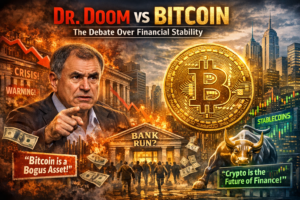
⚠️ 3. What Does He Mean by “Destabilizing the Financial System”?
The heart of Roubini’s warning isn’t just about semantics or asset classification it’s about risk. He thinks that further integration of crypto into traditional banking could create systemic vulnerabilities.
🔹 The GENIUS Act and Stablecoins
One major point of contention is the GENIUS Act proposed legislation that would integrate stablecoins into traditional financial systems. Roubini called it the “Reckless Idiot Act” a harsh rebuke, not an official label emphasizing the law doesn’t provide deposit insurance or lender-of-last-resort mechanisms.
He worries that:
-
Interest-bearing stablecoins could destabilize banks by drawing deposits away
-
Lack of infallible regulation could spur bank runs
-
Crypto assets moving into lightly regulated spaces could amplify panic contagion during stress periods
In simple terms: if people suddenly lose confidence and attempt to redeem crypto assets en masse particularly stablecoins this could ripple into the wider financial system, much like deposit runs undermine bank stability.
📉 4. The Market Context Behind His Critique
Roubini’s comments came during a period of significant market volatility:
-
Bitcoin’s price was down around 45% from its October 2025 peak placing it in bear market territory.
-
Investor sentiment showed rising pessimism, including Google searches for “Bitcoin going to zero” surging.
Even beyond Roubini, other commentators and analysts have suggested Bitcoin lacks consistent use cases beyond speculation.
This backdrop has helped fuel broader skepticism, though whether that skepticism reflects fundamental weakness or cyclical pain remains debated.
📚 5. Understanding the Debate Through Financial Theory
To evaluate Roubini’s critique, we need to ground it in economic fundamentals.
✔️ What Is a “Store of Value”?
A store of value means an asset retains purchasing power over time. Traditionally, gold has filled this role: it’s durable, scarce, and widely accepted.
Bitcoin proponents argue BTC is digital gold easily transferable, limited in supply, and censorship-resistant.
Critics like Roubini counter that Bitcoin’s high volatility undermines its store-of-value claim. Prices can swing wildly within weeks not a trait usually associated with stable stores of value.
✔️ What Is a Currency?
Currencies facilitate trade. They aren’t just stores of value they must support transactions at scale.
Bitcoin’s network can be slow and costly relative to modern payment systems another point skeptics highlight. Supporters counter that second-layer solutions (like Lightning Network) are improving this, but debates persist.
✔️ Asset Class Fundamentals
Stocks generate earnings, bonds pay interest, and commodities have industrial uses. Bitcoin, critics argue, doesn’t produce cash flows or yield, making traditional valuation frameworks difficult or inapplicable.
Proponents respond that Bitcoin’s value derives from scarcity (like gold), decentralization, and global demand but this is still unconventional relative to classic financial theory.
🧩 6. Counterarguments: What Other Experts Say
Though Roubini’s views are influential, many experts strongly disagree:
📈 Bitcoin As an Inflation Hedge
Some investors assert Bitcoin protects against fiat currency devaluation akin to gold. Historical price behavior in some market environments has supported this narrative. Critics say this role isn’t consistent or reliable.
🤝 Institutional Adoption
Major financial institutions now hold and trade Bitcoin derivatives, ETFs exist in many markets, and Bitcoin futures trade widely reflecting growing institutional interest.
For example, regulated offerings like 24/7 Bitcoin futures trading at major exchanges expand mainstream access pointing to institutional normalization, not rejection.
⚙️ Technology and Innovation Value
Blockchain the technology underpinning Bitcoin enables decentralized finance (DeFi), tokenized assets, and programmable money. Supporters argue this innovation outweighs volatility concerns in the long run.
📊 7. Why the Debate Matters for Investors
Whether you agree with Roubini or not, his critique highlights critical questions for anyone involved in crypto investing:
✔️ Risk vs. Reward
Understanding that Bitcoin could be highly speculative with structural risks helps investors build more thoughtful strategies.
✔️ Regulatory Impact
Policy decisions like those around stablecoins and broader crypto banking integration will shape market behavior more than ever.
✔️ Diversification and Portfolio Theory
Investors need to assess how (or if) crypto belongs in a diversified portfolio, considering its behavior across cycles.
Academic studies also question Bitcoin’s role in traditional portfolios suggesting it may offer little benefit in risk-adjusted returns without proper hedging strategies.
🤔 8. So Is Bitcoin Actually a “Bogus” Asset?
The short answer: It depends on your framework.
-
From a traditional economics perspective, critics argue it lacks key qualities of currency or investment assets.
-
From a modern decentralized finance perspective, proponents highlight innovation, scarcity, and digital sovereignty.
Notably, markets have historically absorbed radical visions before normalizing them sometimes integrating elements into the mainstream, sometimes allowing them to fade.
In Bitcoin’s case, the debate isn’t just about price it’s about purpose, utility, regulation, and systemic implications.
📍 Conclusion: A Debate Worth Watching
Nouriel Roubini’s attacks on Bitcoin calling it a “bogus” asset and warning of potential financial system destabilization may be polarizing, but they serve a vital role: they push investors and policymakers to question assumptions.
Whether Bitcoin’s critics or supporters ultimately prevail in public perception or institutional adoption, this dialogue is shaping the future of finance.
For investors, students, and observers alike, the key takeaway isn’t picking a side it’s understanding the arguments, grounding decisions in knowledge, and watching how real-world developments play out.
Leave a Reply