

The rapid evolution of digital technologies has transformed how people interact, transact, and exchange value. At the heart of this revolution lies blockchain technology, a decentralized digital ledger system that powers cryptocurrencies like Bitcoin (Bitcoin), enables smart contracts, and promises to redefine industries from finance to healthcare. Understanding blockchain from its core principles to its cutting-edge innovations is crucial for anyone navigating today’s digital economy. This blog post explores blockchain fundamentals and delves into advanced concepts and emerging trends shaping the technology’s future.
1. Introduction to Blockchain Technology
1.1 What is Blockchain?
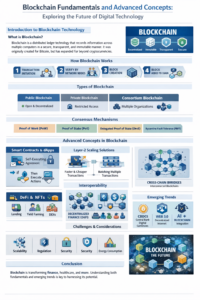
Blockchain is a distributed ledger technology (DLT) that records information across multiple computers in a secure, transparent, and immutable manner. Each record is stored in a block, and these blocks are linked together in a chronological chain, forming the blockchain. The key characteristics of blockchain include:
-
Decentralization: No single entity controls the network. Instead, nodes (participants) collectively maintain and verify the ledger.
-
Immutability: Once data is added to the blockchain, it cannot be altered without consensus from the network.
-
Transparency: Participants can view transaction histories, enhancing trust.
-
Security: Cryptographic techniques secure data against tampering and fraud.
Blockchain was initially popularized by Bitcoin, which leveraged the technology to facilitate peer-to-peer digital transactions without a central authority. Over time, blockchain evolved to support more complex use cases beyond cryptocurrency.
1.2 How Blockchain Works
At a fundamental level, a blockchain operates as follows:
-
Transaction Initiation: A participant requests a transaction (e.g., sending Bitcoin to another user).
-
Verification: Network nodes validate the transaction using consensus mechanisms.
-
Block Creation: Verified transactions are grouped into a block.
-
Block Linking: The new block is cryptographically linked to the previous block.
-
Ledger Update: The updated blockchain is propagated across all nodes.
The decentralized verification process ensures trust without relying on intermediaries like banks or governments. Cryptography guarantees that only authorized users can perform transactions, and tampering with records is computationally infeasible.
1.3 Key Components of Blockchain
To understand blockchain, it is essential to know its key components:
-
Blocks: Contain a list of transactions, a timestamp, and a cryptographic hash of the previous block.
-
Nodes: Computers that participate in the network and maintain copies of the blockchain.
-
Consensus Mechanisms: Protocols that allow nodes to agree on the state of the blockchain (e.g., Proof-of-Work, Proof-of-Stake).
-
Smart Contracts: Self-executing contracts with predefined rules stored on the blockchain.
-
Cryptography: Secures transactions using public/private key pairs and digital signatures.
2. Types of Blockchain
Blockchain networks can be categorized based on access and permission levels:
2.1 Public Blockchain
-
Open to anyone to read, write, and participate.
-
Examples: Bitcoin (Bitcoin), Ethereum (Ethereum)
-
Pros: Decentralized, transparent, censorship-resistant.
-
Cons: Slower transaction speeds, higher energy consumption (especially Proof-of-Work).
2.2 Private Blockchain
-
Access restricted to selected participants.
-
Often used by enterprises for internal operations.
-
Pros: Faster, more efficient, and privacy-focused.
-
Cons: Centralization reduces trustlessness.
2.3 Consortium Blockchain
-
A hybrid of public and private blockchains.
-
Multiple organizations share control.
-
Pros: Combines efficiency with some decentralization.
-
Cons: Requires trust among consortium members.
3. Consensus Mechanisms
Consensus mechanisms are protocols that ensure all nodes agree on the blockchain state. They are critical for security and decentralization. Common mechanisms include:
3.1 Proof-of-Work (PoW)
-
Nodes (miners) solve complex mathematical puzzles to validate transactions.
-
Energy-intensive but highly secure.
-
Used by Bitcoin and many early cryptocurrencies.
3.2 Proof-of-Stake (PoS)
-
Validators stake cryptocurrency to participate in block creation.
-
More energy-efficient than PoW.
-
Used by Ethereum 2.0 and Cardano.
3.3 Delegated Proof-of-Stake (DPoS)
-
Stakeholders elect delegates to validate transactions.
-
Faster and scalable, used by EOS and TRON.
3.4 Practical Byzantine Fault Tolerance (PBFT)
-
Consensus achieved even if some nodes act maliciously.
-
Used in Hyperledger Fabric and other enterprise blockchains.
4. Blockchain Applications
Beyond cryptocurrencies, blockchain has numerous real-world applications:
-
Finance and Payments: Cross-border payments, remittances, decentralized finance (DeFi).
-
Supply Chain Management: Tracking goods from origin to consumer.
-
Healthcare: Secure patient records and drug supply chains.
-
Voting Systems: Transparent, tamper-proof elections.
-
Intellectual Property: Protecting digital assets and copyrights
5. Advanced Concepts in Blockchain
As blockchain matures, new technologies are emerging to address its limitations and expand its capabilities.
5.1 Smart Contracts
Smart contracts are self-executing agreements stored on the blockchain. They automatically enforce rules when predefined conditions are met. Example use cases:
-
Automated insurance claims
-
Escrow services in e-commerce
-
Decentralized finance (lending, borrowing)
Ethereum popularized smart contracts, but newer platforms like Solana and Cardano have improved scalability and efficiency.
5.2 Layer-2 Solutions
Layer-2 solutions aim to scale blockchains without compromising decentralization. They operate on top of existing blockchains. Examples include:
-
Lightning Network (Bitcoin): Enables fast, low-cost transactions off-chain.
-
Rollups (Ethereum): Bundles multiple transactions into a single batch to reduce congestion.
These solutions are essential for mass adoption, especially for high-volume applications like payments and gaming.
5.3 Interoperability and Cross-Chain Solutions
As more blockchains emerge, interoperability becomes crucial:
-
Bridges connect different blockchains, allowing asset transfers.
-
Examples: Polkadot, Cosmos.
-
Benefits: Users can move assets and data across chains seamlessly.
5.4 Privacy-Enhancing Technologies
Privacy remains a challenge in transparent blockchains. Emerging solutions include:
-
Zero-Knowledge Proofs (ZKPs): Prove transaction validity without revealing details.
-
CoinJoin and mixers: Obscure transaction paths.
-
Privacy coins: Monero, Zcash.
5.5 Decentralized Finance (DeFi)
DeFi leverages blockchain to recreate financial services without intermediaries:
-
Lending and borrowing platforms: Aave, Compound
-
Decentralized exchanges (DEXs): Uniswap, SushiSwap
-
Yield farming and staking
DeFi has introduced billions in liquidity but also faces regulatory scrutiny and smart contract risks.
5.6 Non-Fungible Tokens (NFTs)
NFTs are unique digital assets representing ownership:
-
Art, music, virtual real estate
-
Immutable proof of ownership stored on blockchains
-
Expanding into gaming, collectibles, and the metaverse
5.7 Tokenization of Assets
Real-world assets like real estate, stocks, or commodities can be digitally represented on blockchains. Benefits include:
-
Increased liquidity
-
Fractional ownership
-
Reduced intermediaries
5.8 Consensus Upgrades and Energy Efficiency
Blockchain networks are moving toward eco-friendly consensus mechanisms:
-
Ethereum switched from PoW to PoS (Ethereum 2.0)
-
Other networks exploring hybrid or low-energy models
-
Reduces environmental impact while maintaining decentralization
6. Emerging Trends in Blockchain
6.1 Enterprise Adoption
-
Corporations are exploring private and consortium blockchains.
-
Supply chain transparency, banking operations, and secure data sharing.
6.2 Central Bank Digital Currencies (CBDCs)
-
Governments are experimenting with digital currencies on blockchain.
-
Examples: Digital Yuan (China), Digital Euro (EU pilot)
-
Potential for faster payments and financial inclusion
6.3 Web3 and Decentralized Internet
-
Web3 leverages blockchain to create a user-owned, decentralized internet.
-
Focus on privacy, data ownership, and censorship resistance.
6.4 Layer-0 and Infrastructure Improvements
-
Protocols like Polkadot (relay chains) and Cosmos (hub-and-spoke) improve interoperability and network efficiency.
-
Reduces fragmentation across multiple blockchains.
6.5 Blockchain and AI Integration
-
Combining blockchain with AI for:
-
Secure, decentralized data sharing
-
Auditable AI model training
-
AI-driven DeFi trading strategies
-
7. Challenges and Considerations
Despite its promise, blockchain faces several challenges:
-
Scalability: Transaction speed and network congestion remain concerns.
-
Regulation: Governments are developing frameworks for crypto, DeFi, and NFTs.
-
Security: Smart contract bugs and exploits can lead to significant losses.
-
Energy Consumption: PoW networks are energy-intensive, prompting eco-friendly alternatives.
-
Adoption: Bridging the gap between traditional industries and decentralized technologies.
8. Conclusion
Blockchain technology represents a paradigm shift in how we exchange value, secure data, and organize society. From its fundamental principles of decentralization, immutability, and transparency to advanced concepts like smart contracts, DeFi, NFTs, and cross-chain interoperability, blockchain is reshaping the digital landscape.
The next decade will see blockchain integration into finance, healthcare, governance, and beyond. For businesses, developers, and enthusiasts, understanding both fundamentals and emerging trends is critical to harnessing its full potential. As the ecosystem evolves, blockchain will continue to offer transformative opportunities for innovation, efficiency, and trust in a digital-first world.
Leave a Reply